
/webcode.jsp
/en/search/index.jsp
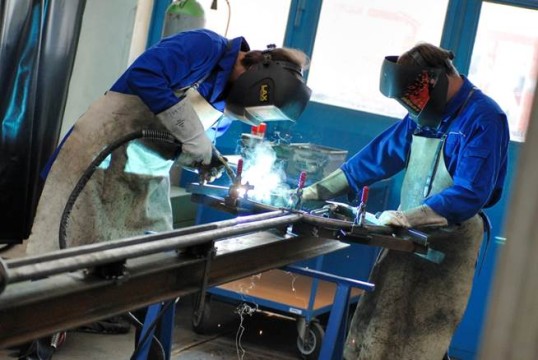
Welding work is associated with radiation emissions. Both optical radiation and electromagnetic fields present a hazard to workers’ safety and health.
Source: IFA
To many people, the term "radiation" has negative connotations. The hazards of radioactive radiation are known; radiation from mobile phones is a cause for concern. In physics, the term "radiation" is much more general and refers to the dissipation of energy in the form of electromagnetic waves of a wide range of wavelengths. It thus encompasses such diverse forms of radiation as radio waves, visible light and hard X-ray radiation.
Altogether, radiation can be divided into two broad groups: ionizing and non-ionizing radiation. This distinction refers to the radiation’s ability to ionize atoms or molecules, i.e. to separate an electron from them.
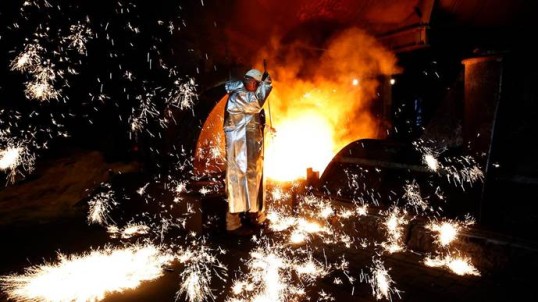
Liquid metal emits infrared radiation to which workers may be exposed.
Source: IFA
Non-ionizing radiation (NIR) can be subdivided further into electromagnetic fields (EMF) and optical radiation (OR), which will be discussed below. It has both desirable and undesirable effects on human beings.
Optical radiation is electromagnetic radiation in the wavelength range from 100 nm (ultraviolet radiation) to 1 mm (far infrared). A distinction is drawn between natural and artificial optical radiation.
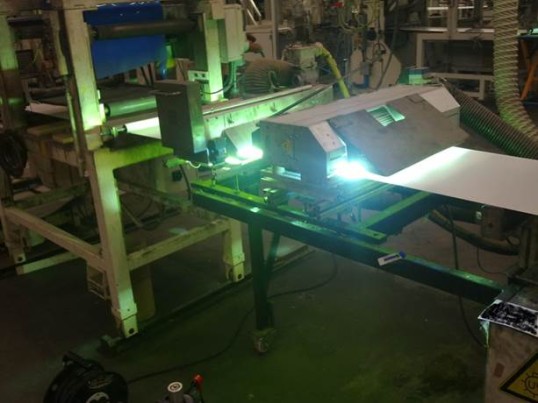
Ultraviolet radiation is often used to dry printing inks or lacquers.
Source: IFA
Numerous different sources generate artificial optical radiation: examples are LEDs (light emitting diodes), lasers and welding equipment. Owing to their properties, these sources must also be treated differently with regard to the potential hazards to which they give rise. A further distinction is therefore drawn here, namely between artificial incoherent and coherent radiation.