/webcode.jsp
/en/search/index.jsp
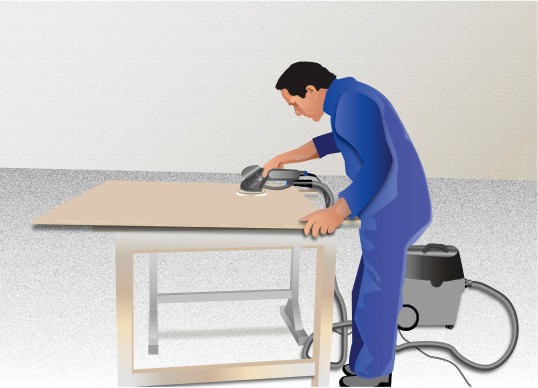
Source: BGHM
Activities involving the handling or release of hazardous substances often require measures to prevent contamination of the air, to ensure that workers are not exposed to impermissibly high concentrations of hazardous substances at their workplaces.
As a rule, hazardous substances are extracted directly at the workstation or in the work area and captured in filtration units or systems. This machinery often employs textile filter media to capture particulate substances. The requirements to be met by the filtration action of the filter media differ according to the substances’ toxicological properties. Hazardous substances that are classified for example as carcinogenic, mutagenic or reprotoxic (CMR substances) necessitate filter media with a particularly high filtration efficiency; by contrast, substances with a lower hazard potential (e.g. those irritating to the respiratory tract) may also be captured by means of filters of lower efficiency.
The Institute for Occupational Safety and Health of the German Social Accident Insurance (IFA) studied the filtration properties of filter materials and filter elements in the context of product testing. A range of test methods exist for assessing the filtration properties of filter media. These methods are typically described in standards.
The IFA makes use of two methods. These are set out in Annex AA to DIN EN 60335-2-69:2015-07, Household and similar electrical appliances - Safety - Part 2-69: Particular requirements for wet and dry vacuum cleaners, including power brush for commercial use.
In this test method (sub-clause 22.AA.201.1 of DIN EN 60335-2-69:2015-07), dust is applied in a dust channel to filter material samples (six discs, each 100 cm² in area, punched out of the unpleated filter material beforehand). Quartz dust, which is classified by airflow within the dust channel, serves as the test dust. At the measurement points, 90% of the particles (by number) have a Stokes diameter of 0.2 μm to 2 μm. Each disc is coated with dust for one hour. An integrating aerosol photometer is used to measure the particle concentrations in the dusty air upstream of the filter (unfiltered air) and the downstream air purified by the filter samples (clean air). These concentrations are used for calculation of the separation and penetration. The concentration of dust in the air flowing through the dust channel is 200 ± 20 mg/m³.
The air volume flow rate under test conditions is set with reference to the air-to-cloth ratio specified beforehand by the manufacturer in the application for testing. The penetration is determined for each individual disc as a value averaged over the test duration. The arithmetic mean of the six individual penetrations increased by twice the standard deviation must be less than the penetration stated in the table. Increasing the mean value by twice the standard deviation means that, with a statistical certainty of 90%, at least 85% of the individual penetrations will be below the value corresponding to the mean value increased by twice the standard deviation.
The test method does not take account of possible scatter in the product, for example between batches. Nor is the cleaning behaviour of filter materials studied.
Table: Dust classes to DIN EN 60335-2-69:2015-07 Annex AA
| For hazardous, dry dusts | Filter material/filter element | ||
| Dust class | Requirements to be met for: | ||
| Penetration | Efficiency | ||
| Where OEL > 1 mg/m³ | L (light) | < 1% | > 99% |
| Where OEL ≥ 0.1 mg/m³ | M (medium) | < 0.1% | > 99.9% |
| Where OEL < 0.1 mg/m³, CMR substances | H (high) | < 0.005% | > 99.995% |
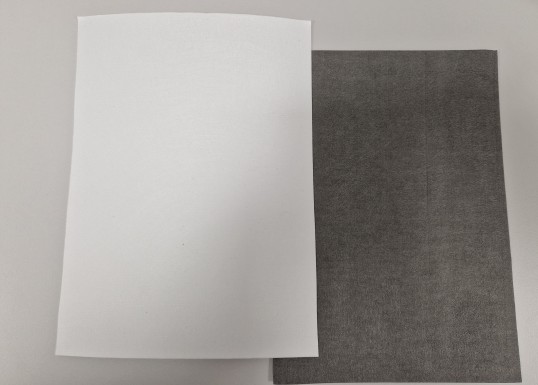
DIN A4 filter material samples
Source: IFA
The test method (sub-clause 22.AA.201.2 to DIN EN 60335-2-69:2015-07) is similar to that described for classes L/M; in this case, however, a paraffin oil mist is used as the test aerosol, in which at least 90% of the droplets (by number) have a Stokes diameter of less than 1 μm. The paraffin oil mist concentration range lies between 10 mg/m³ and 80 mg/m³.
Here too, the test is performed on six discs of the material each with an effective filter area of 100 cm². The test is performed under the airflow conditions (air-to-cloth ratios) specified by the manufacturer. An integrating aerosol photometer is also used to determine the penetration. The filter material is deemed to have passed the penetration test when the arithmetic mean of the individual penetrations increased by twice the standard deviation is less than 0.005%.
In addition to the penetration test performed on the filter material samples, the penetration of the filter element when ready for use is also determined for dust class H. One again, paraffin oil mist is used as the test aerosol. The penetration determined for the filter element must also be < 0.005%. The test as a whole for a dust class H filter is deemed passed when all sub-tests have been passed.
The self-cleaning behaviour of dust class H filters is not studied.
Box-like filter elements with a cross-sectional area of 610 × 610 mm² and a depth of up to 292 mm and cylindrical filter elements with a maximum diameter of 450 mm and a depth of up to 450 mm can be tested at the IFA.

Cylindrical filter element with adapter plate and marking on the upstream side
Source: IFA